Cutmix As A Strong Regularizer
I wrote an app to classify an object using transfer learning, and the model was trained on CIFAR-10 dataset, all by myself.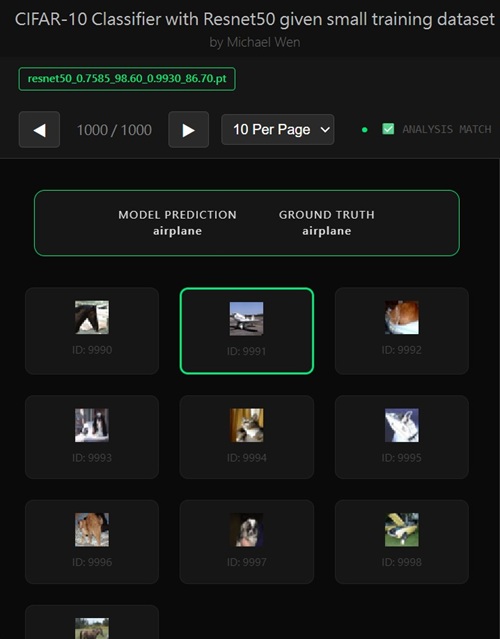
CutMix as a Strong Regularizer
CutMix is often described casually as “cut a patch from one image and paste it into another.” That description is technically correct — but wildly undersells what CutMix actually does to the training objective. CutMix is not just data augmentation. It is a label-space and input-space regularizer at the same time.What CutMix Does at a High Level
Given two training samples:(x₁, y₁), (x₂, y₂)CutMix constructs a new sample:
x̃ = M ⊙ x₁ + (1 − M) ⊙ x₂ ỹ = λ y₁ + (1 − λ) y₂Where:
Mis a binary spatial mask (a rectangle)λis the area ratio of the masky₁, y₂are one-hot or smoothed labels
Why CutMix Is Stronger Than Random Erasing
Random Erasing removes information. CutMix replaces information with structured, meaningful content. This forces the model to:- Recognize multiple objects in one image
- Associate spatial regions with different labels
- Learn part-to-label consistency
How CutMix Changes the Loss Function
Standard cross-entropy:L = − Σ yᵢ log pᵢWith CutMix, the target is no longer discrete:
L = − [ λ log p(y₁ | x̃) + (1 − λ) log p(y₂ | x̃) ]This has two important effects:
- Gradients are shared across classes
- Overconfident predictions are penalized
Effect on Decision Boundaries
Without CutMix, CNNs tend to learn brittle, localized boundaries:- Strong reliance on single object parts
- High confidence predictions
- Poor extrapolation
∂L / ∂logit ≠ 0 for multiple classesThis means:
- The model must distribute probability mass
- Decision boundaries become smoother
- Small perturbations no longer flip predictions
Why CutMix Often Improves Validation Accuracy
CutMix is particularly effective when:- The dataset is small
- Classes share visual features
- Overfitting is the main issue
- Training accuracy (slightly)
- Generalization gap
Why CutMix Can Hurt Transfer Learning
In transfer learning, the backbone is pretrained to recognize whole objects. CutMix breaks that assumption. Potential failure modes:- Pretrained filters expect coherent objects
- Mixed spatial semantics confuse mid-level features
- Early unfreezing amplifies gradient noise
Bias ↑ Variance ↑If model capacity is not constrained, the network simply memorizes mixed patterns.
CutMix and Fine-Tuning Stages
CutMix works best when:- Applied after classifier convergence
- Most backbone layers are frozen
- Learning rates are low
- Stage-1: no CutMix
- Stage-2: mild CutMix (small patches)
- Late training: optional increase in probability
CutMix vs MixUp
- MixUp blends pixels globally
- CutMix blends pixels spatially
- CutMix preserves local textures
- MixUp enforces global linearity
When to Use CutMix
CutMix shines when:- Validation accuracy has plateaued
- Training accuracy is too high
- Data diversity is limited
- The backbone is still adapting
- The dataset is extremely small
- Objects occupy most of the image
Key Takeaways
- CutMix is a label-aware strong regularizer
- It reshapes the loss, not just the inputs
- It smooths decision boundaries
- Timing matters more than strength
- In transfer learning, less is often more
Any comments? Feel free to participate below in the Facebook comment section.