Experiment With Mixup
I wrote an app to classify an object using transfer learning, and the model was trained on CIFAR-10 dataset, all by myself.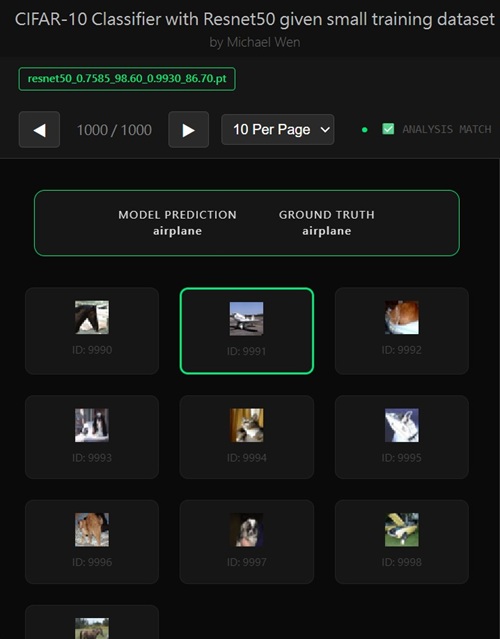
Why MixUp Makes Training Metrics Look Chaotic — and Why That’s a Good Sign
When MixUp is introduced into a two-stage fine-tuning setup, the first thing most readers notice is that the training metrics suddenly look unstable (look below).Training accuracy jumps dramatically from epoch to epoch (look below).
Training loss oscillates instead of decreasing smoothly (look below).
At the same time, validation loss steadily decreases and validation accuracy continues to rise (look below).
At first glance, this feels counterintuitive — almost as if training has become unstable.
In reality, this behavior is exactly what a correctly implemented MixUp pipeline is expected to produce.
To understand why, we need to revisit what MixUp actually changes in the learning objective and how that affects the meaning of standard metrics.
What MixUp Changes at a Fundamental Level
MixUp modifies the training distribution itself.Instead of learning from samples of the form:
(image A, class A)The model is trained on synthetic samples:
λ · image A + (1 − λ) · image B
λ · label A + (1 − λ) · label B
where λ is sampled from a Beta distribution (α = 0.2 in my setup).
This single change has deep implications for how we should interpret training accuracy, training loss, and their relationship to validation metrics.
1. Why Training Accuracy Jumps Up and Down by Large Amounts
Training accuracy becomes semantically incorrect under MixUp
Training accuracy is still computed using hard labels:argmax(prediction) == original_classHowever, MixUp trains the model against soft targets that intentionally contain ambiguity.
Example:
Target: 0.7 cat + 0.3 dog
Prediction: 0.55 dog + 0.45 cat
From a MixUp loss perspective, this is a reasonable prediction.
From an accuracy perspective, it is counted as wrong.
Because each mini-batch contains randomly mixed pairs with different λ values, the apparent training accuracy becomes highly noisy.
- Accuracy no longer reflects learning progress
- Accuracy is dominated by random pairing and interpolation ratios
- Large epoch-to-epoch swings are expected
23.5% → 8.8% → 32.8% → 8.7%Nothing is unstable — the metric is simply misaligned with the training objective.
2. Why Training Loss Also Jumps Up and Down
MixUp intentionally injects optimization noise
Under MixUp, the loss surface becomes more complex:- The model must predict calibrated probability distributions
- Overconfident predictions are penalized
- Each batch represents a different synthetic task
As a result:
- Loss values respond sensitively to small logit shifts
- Batch composition changes dominate short-term loss behavior
- Smooth monotonic loss curves are no longer expected
3. Why Validation Loss Goes Down Despite Chaotic Training Metrics
Validation evaluates the representation, not the training objective
Validation is performed on:- Clean images
- True, unmixed labels
- A fixed, stationary data distribution
Instead, it reshapes the learned feature space indirectly.
What the model actually learns
- Smoother transitions between classes
- Wider, flatter decision boundaries
- Reduced reliance on brittle, high-frequency cues
This is why validation loss decreases steadily even when training loss appears unstable.
4. Why Validation Accuracy Goes Up Despite Erratic Training Accuracy
Generalization improves even when memorization is suppressed
MixUp prevents the network from forming overly sharp decision boundaries that perfectly separate the training set but fail on unseen data.Instead, the model is forced to respect this constraint:
Similar inputs must produce similar outputsThis directly improves robustness on real validation images.
- Less overfitting
- Better probability calibration
- Improved class separation under distribution shift
Final Takeaway: This Is Data-Driven Progress, Not Random Luck
The most important conclusion is this:- The strange-looking training metrics are mathematically expected
- The validation improvements are consistent and repeatable
- The behavior aligns with known properties of MixUp regularization
Regularization is working exactly as intendedThis is not intuition or guesswork.
It is inference based on observed learning dynamics, loss behavior, and generalization theory.
In short:
You are no longer optimizing to look good on the training set.
You are shaping the model to perform better on unseen data — and the validation results confirm the decision.
Digging Deeper - How the Cost Function Changes When MixUp Is Added
MixUp does not merely add noise to training data — it fundamentally changes the cost function the model is optimizing.To fully understand why training behavior looks different under MixUp, we need to walk step by step through how the loss is constructed, how gradients are computed, and what the model is truly being rewarded for.
Baseline: Cost Function Without MixUp
Assume a standard classification setup with cross-entropy loss.For a single training example with true class y and model logits z:
p = softmax(z)
Loss = -log(p[y])
Key properties of this objective:
- The target label is one-hot
- Only one class is considered correct
- The loss pushes probability mass aggressively toward a single class
This encourages sharp decision boundaries and fast memorization — especially on small datasets.
What MixUp Changes Conceptually
With MixUp, we no longer train on a single labeled example.Instead, two samples are combined:
x̃ = λ · x₁ + (1 − λ) · x₂
ỹ = λ · y₁ + (1 − λ) · y₂
where:
- x₁, x₂ are input images
- y₁, y₂ are one-hot labels
- λ ∈ (0, 1) is sampled from Beta(α, α)
Cost Function With MixUp
The cross-entropy loss is computed against the soft target ỹ:Loss = - Σᵢ ỹᵢ · log(pᵢ)Where ỹᵢ is actual labels and pᵢ is model's predicted probabilities.
Substituting the MixUp target:
Loss = - [ λ · log(p[y₁]) + (1 − λ) · log(p[y₂]) ]This single equation explains most of MixUp’s training behavior.
Explanation of Each Term in the MixUp Loss Formula
We start from the MixUp cross-entropy loss:Loss = - Σᵢ ỹᵢ · log(pᵢ)and its expanded form for two mixed samples:
Loss = - [ λ · log(p[y₁]) + (1 − λ) · log(p[y₂]) ]Below is a precise, term-by-term explanation so there is zero ambiguity about what each symbol means and why it exists.
pᵢ — Model-Predicted Probability for Class i
pᵢ = softmax(z)ᵢ
- pᵢ is the model’s predicted probability for class i
- It comes from applying softmax to the model’s logits
- All pᵢ values sum to 1
p = [0.55 (cat), 0.45 (dog)]Here:
- p₀ = 0.55
- p₁ = 0.45
ỹᵢ — Soft (Mixed) Target Probability for Class i
ỹ = λ · y₁ + (1 − λ) · y₂
- ỹᵢ is the target probability assigned to class i
- Unlike standard training, ỹ is not one-hot
- It encodes how much each original label contributes to the mixed sample
y₁ = [1, 0]   (cat)
y₂ = [0, 1]   (dog)
λ = 0.7

ỹ = [0.7, 0.3]
So:
- ỹ₀ = 0.7
- ỹ₁ = 0.3
Σᵢ — Sum Over All Classes
Σᵢ ỹᵢ · log(pᵢ)
- The loss considers every class, not just one
- Each class contributes proportionally to its target weight ỹᵢ
- This is why MixUp produces smoother gradients
p[y₁] — Predicted Probability of the First Sample’s True Class
p[y₁]
- y₁ is the class index of the first original sample
- p[y₁] means “the model’s predicted probability for class y₁”
y₁ = cat
p[cat] = 0.55
This term measures how well the model predicts the first component of the MixUp pair.
p[y₂] — Predicted Probability of the Second Sample’s True Class
p[y₂]
- y₂ is the class index of the second original sample
- p[y₂] is the probability assigned to that class
y₂ = dog
p[dog] = 0.45
Why the Loss Splits into Two Terms
Substituting the soft target into cross-entropy:Loss = - Σᵢ ỹᵢ · log(pᵢ)Since only y₁ and y₂ have non-zero weights:
Loss = - [ λ · log(p[y₁]) + (1 − λ) · log(p[y₂]) ]Interpretation:
- The model is rewarded for predicting both classes correctly
- The reward is proportional to how much each sample contributes
- No single class is ever “100% correct”
Intuition Summary
- pᵢ: what the model believes
- ỹᵢ: what the model should believe
- p[y₁]: confidence in the first mixed label
- p[y₂]: confidence in the second mixed label
Key Insight
Once you understand these terms, it becomes clear why MixUp:- Destroys the meaning of training accuracy
- Makes loss noisier but gradients healthier
- Improves validation accuracy despite “ugly” training logs
Concrete Numerical Example
Assume:- Class A = cat
- Class B = dog
- λ = 0.7
ỹ = [0.7 (cat), 0.3 (dog)]Model prediction:
p = [0.55 (cat), 0.45 (dog)]Loss calculation:
Loss = - [0.7 · log(0.55) + 0.3 · log(0.45)]
     ≈ 0.77
Compare this to standard training:
- If cat were the only correct class → loss = -log(0.55) ≈ 0.60
- MixUp penalizes overconfidence and rewards balance
Why Training Loss Becomes Noisy
Each mini-batch introduces new random pairs and new λ values.As a result:
- The target distribution changes every iteration
- The optimal prediction is no longer a one-hot vector
- Small logit changes cause large loss variations
Effect on Gradients
Without MixUp, the gradient pushes hard toward one class:∂Loss/∂zᵢ = pᵢ − 1(y = i)With MixUp:
∂Loss/∂zᵢ = pᵢ − ỹᵢThis means:
- Gradients are smaller and smoother
- No class is ever pushed to probability 1.0
- Learning favors calibrated probabilities
Why Training Accuracy Becomes Meaningless
Accuracy is computed as:argmax(p) == argmax(y)But under MixUp:
- ỹ does not have a single correct class
- Predictions near the optimal distribution can still be marked “wrong”
Relationship to Label Smoothing
MixUp generalizes label smoothing:- Label smoothing distributes mass across all classes
- MixUp distributes mass across specific semantic classes
Why This Cost Function Improves Generalization
Optimizing this loss enforces a powerful inductive bias:If two inputs are similar, their predictions should interpolate smoothlyThis produces:
- Smoother decision boundaries
- Reduced sensitivity to noise
- Better behavior under distribution shift
Final Takeaway
When MixUp is enabled, the model is no longer minimizing “classification error” in the traditional sense.It is minimizing a richer cost function that encodes smoothness, uncertainty, and robustness directly into the objective.
Once you understand the cost function, all the strange-looking training metrics stop being confusing — they become expected, explainable, and reassuring.
Config and Training Logs for Reference
========== CONFIG ==========
NUM_CLASSES = 10
TRAINING_SAMPLE_PER_CLASS = 100
VALIDATION_SAMPLE_PER_CLASS = 100
BATCH_SIZE = 256
EPOCHS = 60
TRAINABLE_LAYERS_STAGE1 = 1
TRAINABLE_LAYERS_STAGE2 = 2
EARLY_STOP_PATIENCE = 100
USE_COSINE_LR = True
COSINE_T_MAX = 60
COSINE_ETA_MIN = 1e-06
USE_MIXUP = True
MIXUP_ALPHA = 0.2
label smoothing = 0.15
============================

===== Stage-1: Train fc only =====
[01/60] Train Loss: 2.4538 | Val Loss: 2.4033 | Train Acc: 7.70% | Val Acc: 14.70%
[02/60] Train Loss: 2.2820 | Val Loss: 2.2168 | Train Acc: 11.40% | Val Acc: 22.00%
[03/60] Train Loss: 2.1846 | Val Loss: 2.0564 | Train Acc: 15.90% | Val Acc: 30.80%
[04/60] Train Loss: 2.1112 | Val Loss: 1.9382 | Train Acc: 24.20% | Val Acc: 36.40%
[05/60] Train Loss: 1.9790 | Val Loss: 1.8447 | Train Acc: 20.10% | Val Acc: 44.70%
[06/60] Train Loss: 1.8874 | Val Loss: 1.7559 | Train Acc: 42.90% | Val Acc: 52.20%
[07/60] Train Loss: 1.7439 | Val Loss: 1.6857 | Train Acc: 23.50% | Val Acc: 57.60%
[08/60] Train Loss: 1.7551 | Val Loss: 1.6398 | Train Acc: 8.80% | Val Acc: 59.00%
[09/60] Train Loss: 1.7286 | Val Loss: 1.6066 | Train Acc: 32.80% | Val Acc: 59.70%
[10/60] Train Loss: 1.6075 | Val Loss: 1.5637 | Train Acc: 36.80% | Val Acc: 62.00%
[11/60] Train Loss: 1.5552 | Val Loss: 1.5315 | Train Acc: 23.80% | Val Acc: 64.30%
[12/60] Train Loss: 1.5919 | Val Loss: 1.5085 | Train Acc: 42.60% | Val Acc: 64.90%
[13/60] Train Loss: 1.4833 | Val Loss: 1.4862 | Train Acc: 8.70% | Val Acc: 65.80%
[14/60] Train Loss: 1.7002 | Val Loss: 1.4808 | Train Acc: 41.70% | Val Acc: 64.90%
[15/60] Train Loss: 1.6000 | Val Loss: 1.4598 | Train Acc: 66.70% | Val Acc: 66.10%
[16/60] Train Loss: 1.5693 | Val Loss: 1.4629 | Train Acc: 48.40% | Val Acc: 64.90%
[17/60] Train Loss: 1.4862 | Val Loss: 1.4475 | Train Acc: 44.20% | Val Acc: 65.10%
[18/60] Train Loss: 1.6148 | Val Loss: 1.4369 | Train Acc: 45.70% | Val Acc: 65.70%
[19/60] Train Loss: 1.5109 | Val Loss: 1.4300 | Train Acc: 49.90% | Val Acc: 65.50%
[20/60] Train Loss: 1.4189 | Val Loss: 1.4157 | Train Acc: 45.10% | Val Acc: 67.00%
[21/60] Train Loss: 1.3092 | Val Loss: 1.4088 | Train Acc: 59.80% | Val Acc: 68.20%
[22/60] Train Loss: 1.3527 | Val Loss: 1.3958 | Train Acc: 44.80% | Val Acc: 67.80%
[23/60] Train Loss: 1.5931 | Val Loss: 1.3922 | Train Acc: 45.20% | Val Acc: 67.90%
[24/60] Train Loss: 1.7500 | Val Loss: 1.4134 | Train Acc: 23.80% | Val Acc: 65.10%
[25/60] Train Loss: 1.2768 | Val Loss: 1.3895 | Train Acc: 45.30% | Val Acc: 68.30%
[26/60] Train Loss: 1.4332 | Val Loss: 1.3798 | Train Acc: 32.90% | Val Acc: 68.60%
[27/60] Train Loss: 1.4859 | Val Loss: 1.3846 | Train Acc: 57.80% | Val Acc: 67.80%
[28/60] Train Loss: 1.5004 | Val Loss: 1.3907 | Train Acc: 37.80% | Val Acc: 66.60%
[29/60] Train Loss: 1.4174 | Val Loss: 1.3818 | Train Acc: 30.00% | Val Acc: 68.40%
[30/60] Train Loss: 1.5095 | Val Loss: 1.3813 | Train Acc: 38.90% | Val Acc: 68.50%
[31/60] Train Loss: 1.3503 | Val Loss: 1.3746 | Train Acc: 27.30% | Val Acc: 68.70%
[32/60] Train Loss: 1.4783 | Val Loss: 1.3773 | Train Acc: 24.30% | Val Acc: 67.50%
[33/60] Train Loss: 1.2495 | Val Loss: 1.3660 | Train Acc: 62.70% | Val Acc: 69.30%
[34/60] Train Loss: 1.2894 | Val Loss: 1.3594 | Train Acc: 46.90% | Val Acc: 69.80%
[35/60] Train Loss: 1.7056 | Val Loss: 1.3801 | Train Acc: 35.60% | Val Acc: 67.70%
[36/60] Train Loss: 1.2149 | Val Loss: 1.3682 | Train Acc: 28.60% | Val Acc: 68.80%
[37/60] Train Loss: 1.4249 | Val Loss: 1.3705 | Train Acc: 9.40% | Val Acc: 68.50%
[38/60] Train Loss: 1.3438 | Val Loss: 1.3629 | Train Acc: 10.90% | Val Acc: 69.20%
[39/60] Train Loss: 1.6903 | Val Loss: 1.3755 | Train Acc: 37.30% | Val Acc: 67.10%
[40/60] Train Loss: 1.5488 | Val Loss: 1.3800 | Train Acc: 38.00% | Val Acc: 67.10%
[41/60] Train Loss: 1.7011 | Val Loss: 1.3965 | Train Acc: 46.20% | Val Acc: 65.80%
[42/60] Train Loss: 1.4152 | Val Loss: 1.3931 | Train Acc: 34.40% | Val Acc: 66.00%
[43/60] Train Loss: 1.2278 | Val Loss: 1.3697 | Train Acc: 62.50% | Val Acc: 68.10%
[44/60] Train Loss: 1.2642 | Val Loss: 1.3602 | Train Acc: 44.20% | Val Acc: 69.60%
[45/60] Train Loss: 1.4752 | Val Loss: 1.3633 | Train Acc: 58.30% | Val Acc: 68.50%
[46/60] Train Loss: 1.3039 | Val Loss: 1.3590 | Train Acc: 25.40% | Val Acc: 69.10%
[47/60] Train Loss: 1.3993 | Val Loss: 1.3570 | Train Acc: 44.40% | Val Acc: 69.30%
[48/60] Train Loss: 1.6299 | Val Loss: 1.3690 | Train Acc: 27.20% | Val Acc: 68.30%
[49/60] Train Loss: 1.2138 | Val Loss: 1.3565 | Train Acc: 46.20% | Val Acc: 69.20%
[50/60] Train Loss: 1.2929 | Val Loss: 1.3551 | Train Acc: 43.60% | Val Acc: 69.30%
[51/60] Train Loss: 1.2729 | Val Loss: 1.3535 | Train Acc: 28.80% | Val Acc: 69.60%
[52/60] Train Loss: 1.3955 | Val Loss: 1.3553 | Train Acc: 60.20% | Val Acc: 69.60%
[53/60] Train Loss: 1.4541 | Val Loss: 1.3574 | Train Acc: 30.60% | Val Acc: 69.30%
[54/60] Train Loss: 1.6126 | Val Loss: 1.3681 | Train Acc: 33.90% | Val Acc: 68.10%
[55/60] Train Loss: 1.3494 | Val Loss: 1.3616 | Train Acc: 49.70% | Val Acc: 68.90%
[56/60] Train Loss: 1.5867 | Val Loss: 1.3702 | Train Acc: 24.10% | Val Acc: 68.20%
[57/60] Train Loss: 1.5149 | Val Loss: 1.3728 | Train Acc: 23.30% | Val Acc: 67.50%
[58/60] Train Loss: 1.3746 | Val Loss: 1.3648 | Train Acc: 20.70% | Val Acc: 68.60%
[59/60] Train Loss: 1.3136 | Val Loss: 1.3619 | Train Acc: 61.80% | Val Acc: 69.00%
[60/60] Train Loss: 1.3522 | Val Loss: 1.3619 | Train Acc: 40.40% | Val Acc: 68.70%

Stage-1 Best results:
Train Loss: 1.2894 | Val Loss: 1.3594 | Train Acc: 46.90% | Val Acc: 69.80%
Stage-1 Training Time: 237.97 seconds

Loaded Stage-1 best-val model for Stage-2 fine-tuning

===== Stage-2: Unfreeze layer4 + fc =====
[01/60] Train Loss: 1.4827 | Val Loss: 1.2912 | Train Acc: 26.20% | Val Acc: 75.10%
[02/60] Train Loss: 1.3821 | Val Loss: 1.2489 | Train Acc: 61.30% | Val Acc: 75.90%
[03/60] Train Loss: 0.9931 | Val Loss: 1.1952 | Train Acc: 53.70% | Val Acc: 78.50%
[04/60] Train Loss: 1.1753 | Val Loss: 1.1775 | Train Acc: 55.10% | Val Acc: 79.40%
[05/60] Train Loss: 1.3549 | Val Loss: 1.1648 | Train Acc: 53.70% | Val Acc: 80.00%
[06/60] Train Loss: 0.9620 | Val Loss: 1.1515 | Train Acc: 31.50% | Val Acc: 81.40%
[07/60] Train Loss: 1.4032 | Val Loss: 1.1609 | Train Acc: 61.90% | Val Acc: 81.80%
[08/60] Train Loss: 0.9119 | Val Loss: 1.1382 | Train Acc: 34.80% | Val Acc: 82.60%
[09/60] Train Loss: 1.1922 | Val Loss: 1.1221 | Train Acc: 71.40% | Val Acc: 83.60%
[10/60] Train Loss: 1.0643 | Val Loss: 1.1156 | Train Acc: 65.00% | Val Acc: 83.50%
[11/60] Train Loss: 1.1285 | Val Loss: 1.1183 | Train Acc: 74.00% | Val Acc: 82.90%
[12/60] Train Loss: 0.8916 | Val Loss: 1.1177 | Train Acc: 55.80% | Val Acc: 83.30%
[13/60] Train Loss: 0.9120 | Val Loss: 1.1151 | Train Acc: 32.70% | Val Acc: 83.40%
[14/60] Train Loss: 0.9319 | Val Loss: 1.1033 | Train Acc: 76.70% | Val Acc: 83.70%
[15/60] Train Loss: 1.2321 | Val Loss: 1.1142 | Train Acc: 76.50% | Val Acc: 84.00%
[16/60] Train Loss: 1.0334 | Val Loss: 1.1162 | Train Acc: 12.70% | Val Acc: 84.40%
[17/60] Train Loss: 0.8715 | Val Loss: 1.1090 | Train Acc: 29.60% | Val Acc: 84.70%
[18/60] Train Loss: 1.0083 | Val Loss: 1.1018 | Train Acc: 69.70% | Val Acc: 84.60%
[19/60] Train Loss: 1.3475 | Val Loss: 1.1144 | Train Acc: 36.50% | Val Acc: 84.60%
[20/60] Train Loss: 1.1397 | Val Loss: 1.1288 | Train Acc: 96.00% | Val Acc: 83.80%
[21/60] Train Loss: 1.0031 | Val Loss: 1.1196 | Train Acc: 36.20% | Val Acc: 84.30%
[22/60] Train Loss: 1.0184 | Val Loss: 1.1032 | Train Acc: 64.60% | Val Acc: 84.70%
[23/60] Train Loss: 0.7571 | Val Loss: 1.0852 | Train Acc: 31.90% | Val Acc: 85.80%
[24/60] Train Loss: 1.1125 | Val Loss: 1.0823 | Train Acc: 15.60% | Val Acc: 86.00%
[25/60] Train Loss: 1.0659 | Val Loss: 1.0955 | Train Acc: 55.50% | Val Acc: 85.90%
[26/60] Train Loss: 0.8838 | Val Loss: 1.1081 | Train Acc: 31.60% | Val Acc: 86.00%
[27/60] Train Loss: 1.1226 | Val Loss: 1.1139 | Train Acc: 31.90% | Val Acc: 85.20%
[28/60] Train Loss: 0.9673 | Val Loss: 1.0937 | Train Acc: 28.30% | Val Acc: 85.40%
[29/60] Train Loss: 0.9817 | Val Loss: 1.0816 | Train Acc: 53.70% | Val Acc: 85.80%
[30/60] Train Loss: 0.9001 | Val Loss: 1.0748 | Train Acc: 34.20% | Val Acc: 85.70%
[31/60] Train Loss: 0.9982 | Val Loss: 1.0776 | Train Acc: 71.70% | Val Acc: 85.80%
[32/60] Train Loss: 0.9805 | Val Loss: 1.0824 | Train Acc: 10.20% | Val Acc: 85.40%
[33/60] Train Loss: 1.2955 | Val Loss: 1.0990 | Train Acc: 26.60% | Val Acc: 84.60%
[34/60] Train Loss: 0.7292 | Val Loss: 1.0914 | Train Acc: 79.10% | Val Acc: 85.60%
[35/60] Train Loss: 0.8313 | Val Loss: 1.0843 | Train Acc: 79.70% | Val Acc: 85.70%
[36/60] Train Loss: 0.9503 | Val Loss: 1.0832 | Train Acc: 53.60% | Val Acc: 85.70%
[37/60] Train Loss: 0.7882 | Val Loss: 1.0816 | Train Acc: 31.20% | Val Acc: 86.00%
[38/60] Train Loss: 0.8548 | Val Loss: 1.0846 | Train Acc: 79.50% | Val Acc: 86.30%
[39/60] Train Loss: 0.7730 | Val Loss: 1.0826 | Train Acc: 54.50% | Val Acc: 86.00%
[40/60] Train Loss: 0.9668 | Val Loss: 1.0825 | Train Acc: 24.00% | Val Acc: 86.40%
[41/60] Train Loss: 0.9407 | Val Loss: 1.0825 | Train Acc: 57.80% | Val Acc: 86.50%
[42/60] Train Loss: 1.0486 | Val Loss: 1.0890 | Train Acc: 33.70% | Val Acc: 86.60%
[43/60] Train Loss: 0.9799 | Val Loss: 1.0948 | Train Acc: 56.70% | Val Acc: 86.20%
[44/60] Train Loss: 0.8374 | Val Loss: 1.0972 | Train Acc: 52.00% | Val Acc: 86.50%
[45/60] Train Loss: 0.8803 | Val Loss: 1.0970 | Train Acc: 33.70% | Val Acc: 86.40%
[46/60] Train Loss: 0.7920 | Val Loss: 1.0935 | Train Acc: 32.80% | Val Acc: 86.40%
[47/60] Train Loss: 1.0537 | Val Loss: 1.0947 | Train Acc: 53.30% | Val Acc: 86.20%
[48/60] Train Loss: 1.0856 | Val Loss: 1.0972 | Train Acc: 55.40% | Val Acc: 86.30%
[49/60] Train Loss: 1.0134 | Val Loss: 1.0964 | Train Acc: 75.10% | Val Acc: 86.30%
[50/60] Train Loss: 0.9977 | Val Loss: 1.0942 | Train Acc: 63.90% | Val Acc: 86.20%
[51/60] Train Loss: 0.9315 | Val Loss: 1.0927 | Train Acc: 79.00% | Val Acc: 86.70%
[52/60] Train Loss: 1.2048 | Val Loss: 1.0955 | Train Acc: 38.00% | Val Acc: 86.30%
[53/60] Train Loss: 1.1794 | Val Loss: 1.0998 | Train Acc: 94.10% | Val Acc: 86.00%
[54/60] Train Loss: 0.9701 | Val Loss: 1.0974 | Train Acc: 78.90% | Val Acc: 86.20%
[55/60] Train Loss: 1.1620 | Val Loss: 1.1006 | Train Acc: 91.70% | Val Acc: 85.90%
[56/60] Train Loss: 0.7646 | Val Loss: 1.0934 | Train Acc: 55.60% | Val Acc: 86.40%
[57/60] Train Loss: 0.8303 | Val Loss: 1.0914 | Train Acc: 76.50% | Val Acc: 86.40%
[58/60] Train Loss: 0.7479 | Val Loss: 1.0883 | Train Acc: 33.70% | Val Acc: 86.10%
[59/60] Train Loss: 0.8376 | Val Loss: 1.0877 | Train Acc: 55.80% | Val Acc: 86.10%
[60/60] Train Loss: 0.7773 | Val Loss: 1.0870 | Train Acc: 34.00% | Val Acc: 86.40%

Stage-2 Best results:
Train Loss: 0.9315 | Val Loss: 1.0927 | Train Acc: 79.00% | Val Acc: 86.70%
Stage-2 Training Time: 312.37 seconds
Any comments? Feel free to participate below in the Facebook comment section.